
Loading
DHA Campus, IslamabadMandra Campus, Rawalpindi
Diagnostic assessment and national data
Building a culturally relevant, validated approach to identifying mental health conditions in adolescents and adults in community settings — and contributing to Pakistan's National Mental Health Data Dashboard.
The challenge
Accurate identification of mental health conditions is essential for effective care, research and health-system planning. Yet diagnostic tools developed in one cultural and linguistic context cannot always be directly transferred to another.
Pakistan needs assessment approaches that are culturally relevant, linguistically appropriate and practical for use across diverse settings.
The research
GIHD is translating, culturally adapting and pilot validating the WHO Flexible Interview for ICD-11 (FLII-11) for adolescents and adults in Pakistan.
The research combines qualitative cultural adaptation, including engagement with people with lived experience, with quantitative validation against clinical diagnostic assessments. The adapted tool will be evaluated for reliability and accuracy in identifying mental health conditions in the Pakistani context.
Four-stage validation methodology
Stage 01
Forward and back-translation between English and Urdu by bilingual mental health professionals to ensure conceptual fidelity.
Stage 02
Examining local symptom terminology, idioms of distress, and contextual understanding of diagnostic concepts in Pakistan.
Stage 03
Cognitive interviewing and focus groups with adolescents, adults, and clinical specialists to evaluate clarity and acceptability.
Stage 04
Testing the adapted instrument against independent clinician diagnoses in 240 adolescents and adults to establish diagnostic accuracy.
This page documents a diagnostic research project. GIHD's website does not provide self-assessment or online diagnostic screening.
The authorized FLII-11 Urdu assessment manual will be made accessible to certified clinical researchers following trial completion and WHO clearance.
From research to national data
The Government of Pakistan has directed the development of a National Mental Health Data Dashboard, in collaboration with the National Institute of Health, to strengthen evidence-based planning, monitoring and decision-making.
The FLII-11 work will contribute to this broader effort to strengthen the country's capacity to generate and use reliable mental health data.
What could this research change?
Identification
Improve the culturally appropriate identification of mental health conditions among adolescents and adults.
Research
Provide a validated ICD-11-aligned assessment approach for mental health research in Pakistan.
Services
Support more consistent identification and referral within community, primary healthcare and school-based programmes.
Data
Strengthen the evidence base for mental health planning, monitoring and national decision-making.
Global Standards → Local Evidence → Better Data → Better Care
Partners and collaborators
 World Health Organization (WHO)
 Ministry of National Health Services, Regulations & Coordination
Connected work
A longitudinal study generating high-quality evidence on how individual and combined stressors contribute to the onset of depressive symptoms in young people, in Pakistan, Indonesia and Colombia.
Pakistan, Indonesia, Colombia

Can technology make it possible to train and supervise more non-specialist school counsellors, without compromising the quality of care they provide? A randomised test of technology-assisted cascade training and supervision for EASE.
Pakistan
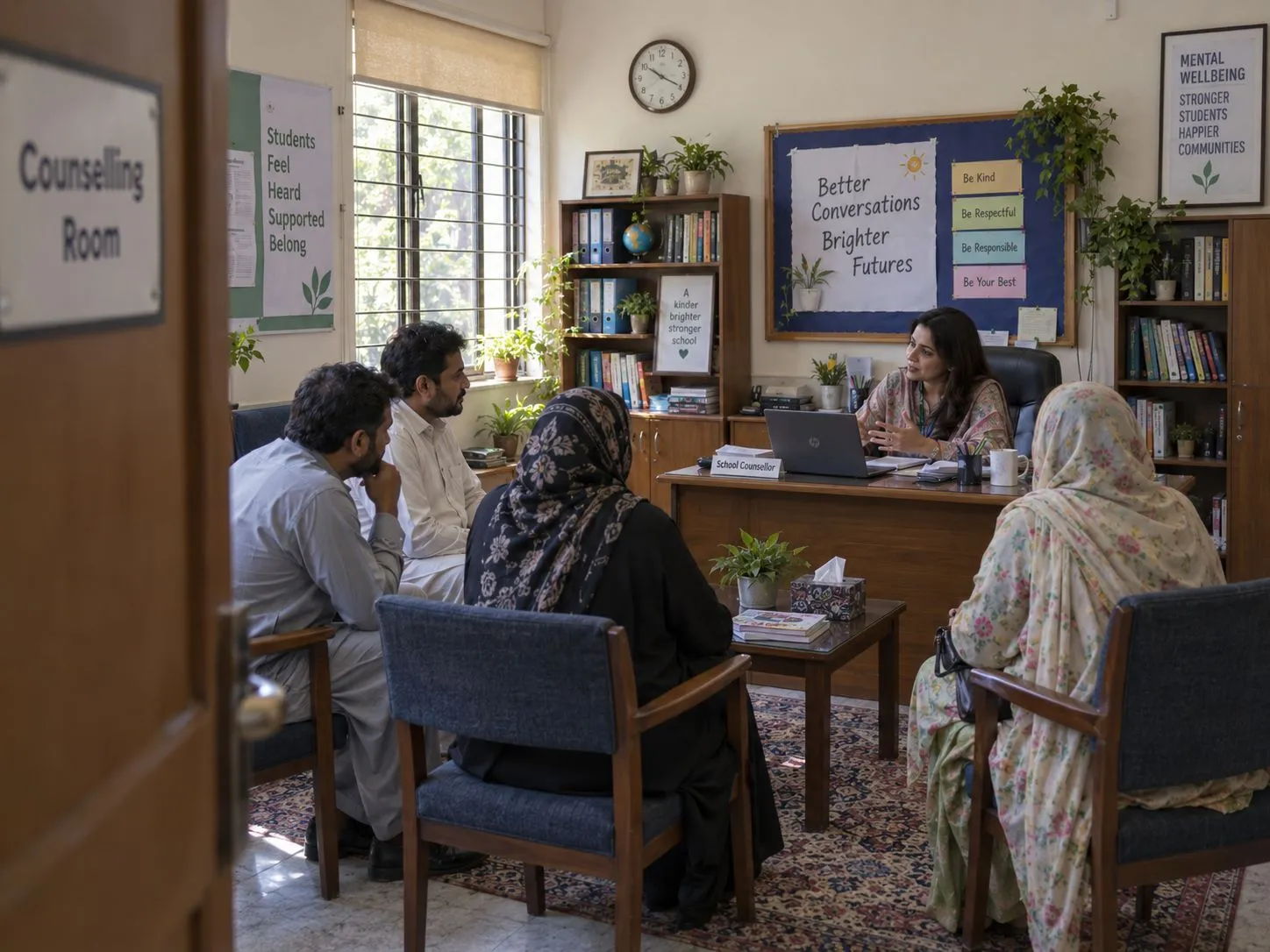
PREVENT is a school- and community-based programme designed to strengthen adolescent mental wellbeing by placing family support at the heart of prevention.
Pakistan
Collaborate with GIHD
GIHD partners with international research institutions, government and UN agencies. Get in touch to discuss collaboration, data or publications.
Monday to Friday, 9 am to 5 pm