
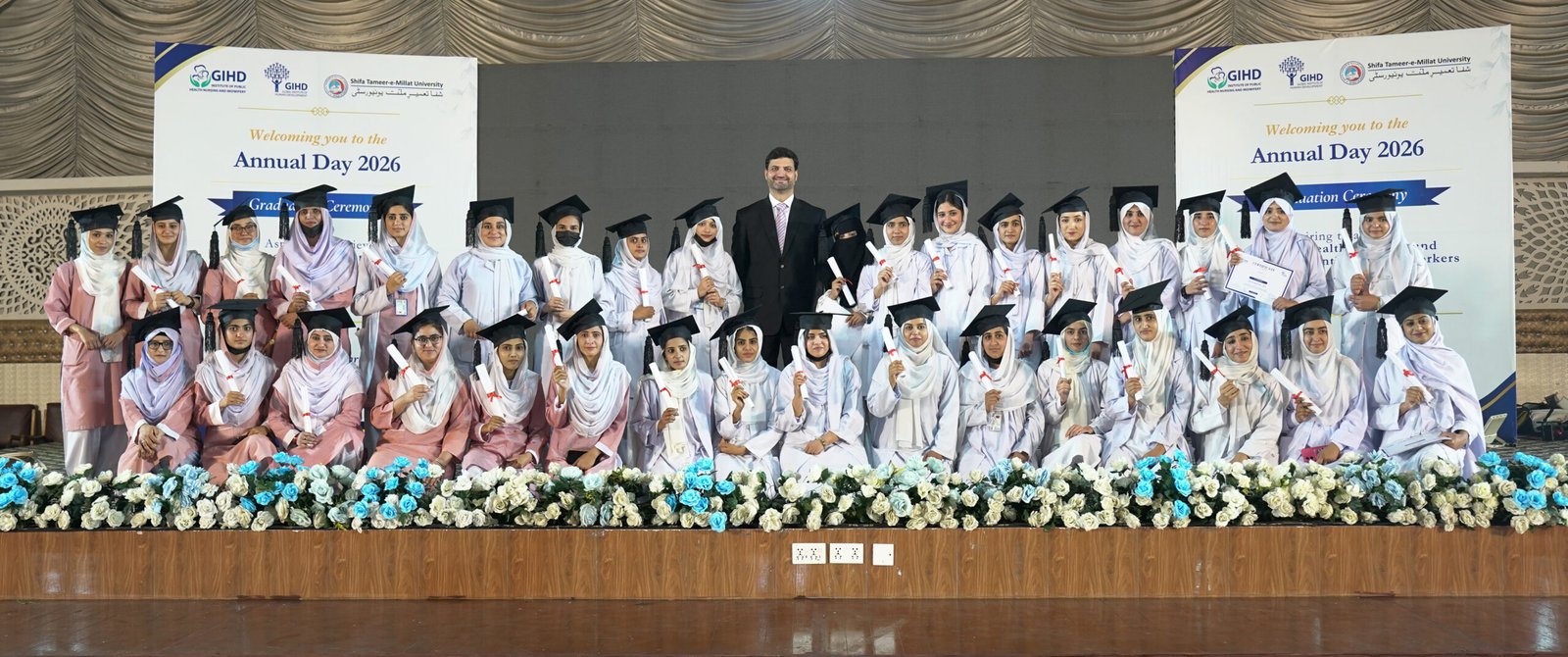
Strengthening Pakistan’s Frontline Health Systems through Policy–Academia Integration and Chief Minister Punjab Maryam Nawaz’s Community Health Inspector (CHI) Program Islamabad, April 7, 2026 — The Global Institute of Human Development (GIHD) at Shifa Tameer-e-Millat University (STMU) convened its Annual Day and Graduation Ceremony, showcasing a scalable model of policy–academia integration to strengthen Pakistan’s health systems and advance human development. The event brought together senior leadership from government, district health systems, academia, and development partners. The Honourable Minister of State for National Health Services, Regulations and Coordination, Dr. Malik Mukhtar Ahmad Bharath was the Chief Guest. The event was hosted by Prof. Dr. Muhammad Iqbal Khan, Vice Chancellor, Shifa Tameer-e-Millat University, Dr. Syed Usman Hamdani, Director GIHD, and Dr. Ehsan Ghani, CEO District Health Authority Rawalpindi. Addressing the gathering, the Honourable Minister congratulated the academic leadership on aligning education, service delivery, and research with national health priorities, such as the Chief Minister Punjab Maryam Nawaz’s Community Health Inspector (CHI) Program noting that such integrated models are essential to strengthening Pakistan’s health systems and enabling scale. The Minister reaffirmed the commitment of the Government of Pakistan to support initiatives that bridge academia, policy and implementation, ensuring sustainable and evidence-based solutions for our communities. A defining feature of the event was the strong integration of academia with district health systems. Dr. Ehsan Ghani, CEO District Health Authority, Rawalpindi, highlighted the efforts to ensure that training translates into deployment and community service, with graduates already embedded within the health system to meet local needs. He highlighted the close alignment of the initiative with the Chief Minister Punjab Maryam Nawaz’s Community Health Inspector (CHI) Program, a flagship effort to strengthen household-level access to essential health services. By expanding the pool of trained Lady Health Visitors (LHVs) and Community Midwives (CMWs), the CM Punjab initiative supports, enhanced community-level service delivery, improved maternal and child health outcomes, strengthened preventive and promotive care. The ceremony marked the graduation of LHV and CMW students from Institute of Public Health Nursing and Midwifery (IPHNM)-GIHD, many of whom are already serving within district health systems through the CM Punjab CHI Initiative. This model ensures, competency-based training, system-linked deployment and immediate contribution to women empowerment and quality healthcare delivery in rural community settings. A key innovation of the model is the integration of mental health into primary care and community platforms, aligned with Pakistan’s commitment to Universal Health Coverage (UHC). This approach demonstrates a practical pathway where policy, academia, and implementation converge to address local needs by delivering measurable impact at scale. The convergence of policy leadership, district implementation, and academic innovation represents a clear pathway toward strengthening Pakistan’s health systems and advancing human development. Contact Us Email: info@gihd.edu.pkPhone: +92-333-0590373
Strengthening Child and Adolescent Mental Health Systems Across South Asia- a landscape analysis
Strengthening Child and Adolescent Mental Health Systems Across South Asia- a landscape analysis As part of CAMHSAN’s mission to advance child and adolescent mental health across the region, a regional mapping initiative was undertaken to generate a foundational evidence base that can guide policy reform, investment, and service strengthening across South Asia. Conducted across Afghanistan, Bangladesh, Bhutan, India, Maldives, Nepal, Pakistan, and Sri Lanka, and using the UNICEF Child and Adolescent Mental Health (CAMH) Mapping Tool, the assessment draws on policy reviews, service data, and expert consultations to profile existing systems and identify priority gaps and opportunities for action. A Regional Call for Action This landmark report underscores the urgent need to scale child and adolescent mental health responses in South Asia, where nearly 40% of the population is under 18. Findings reveal significant system challenges, including: Limited financing for mental health services A shortage of trained specialists Concentration of services in urban tertiary hospitals Minimal community- and school-based programming Despite growing recognition of mental health needs, most countries lack dedicated policies, trained human resource, evidence-based mental health programs/services, costed action plans, and integrated service pathways for early intervention and ongoing care. Building Stronger Systems for Every Young Person Through this collaborative effort, CAMHSAN strengthens the regional agenda on child and adolescent mental health, supporting governments, partners, and practitioners to build equitable, community-anchored, and evidence-based mental health systems for every young person in South Asia. Report Authors Commissioned by UNICEF, this landmark Child and Adolescent Mental Health (CAMH) Mapping Analysis was conducted across eight South Asian countries by Dr. Syed Usman Hamdani and Prof. Savita Malhotra supported by in-country partners.